Registration for Regist Now
The Employee Class Program (RPL, Program and Level Transfer Categories) for TA 2024-2025 has been opened. More Info
"Overweight" and "obesity." These two terms might seem similar at first glance, but they actually have different meanings. Being overweight doesn't necessarily mean obesity. However, someone with obesity is definitely overweight. Confused? Let's discuss it in more detail.
The rate of obesity in Indonesia is still relatively high. According to the 2018 Basic Health Research (Riskesdas) data, about 21.8 percent of the adult population in Indonesia is obese. This means that 1 in every 5 people experiences obesity.
What is Obesity?
Obesity is an excessive nutritional issue. The excess referred to here doesn't align with the body's needs. What's excessive? The excessive intake of carbohydrates and fats into the body is what's referred to as obesity.
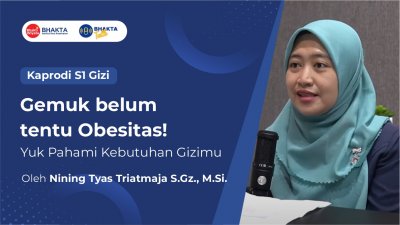
"People often misunderstand obesity and being overweight. Yet, they are similar but different," explains Nining Tyas Triatmaja, S.Gz., M.Si, the Head of the Nutrition S1 program at IIK Bhakti Wiyata. She continues by stating that both obesity and being overweight are issues of excessive nutrition. However, someone with obesity is definitely overweight, while someone who is overweight isn't necessarily obese.
Are We Currently Obese?
Obesity cannot be solely determined by visual observation. We can determine whether we fall into the obesity category or not through the Body Mass Index (BMI) value. This is a simple index that measures the balance between body weight and height, with the following equation:
BMI = Weight / (Height x Height)
The weight is measured in kilograms (kg) and the height in meters (m). For example, if you weigh 57 kg and have a height of 165 cm or 1.65 m, the BMI is calculated as: 57 / (1.65 x 1.65) = 20.9.
Next, you can determine whether you fall into the obesity category based on the following scale.
| BMI Value | Category |
| <18.5 | Underweight |
| 18.5 - 25 | Normal |
| <25 | Obese |
From the example calculation, a BMI of 20.9 falls into the normal category. Nining recommends weighing yourself in the morning, after waking up and before breakfast. "Don't do it randomly. There's an appropriate time. When your stomach is still empty," she says.
In addition to the BMI index, the measure of obesity can also be determined by waist circumference. Women are considered obese if their waist circumference is above 80 cm. For men, a waist circumference above 90 cm falls into the obesity category. This is known as central obesity. This type of obesity is more dangerous than regular obesity. "We often refer to it as a pot belly," Nining explains.
The Dangers of Obesity
Obesity can disrupt the body's health. Accumulated fat can lead to narrowing of blood vessels. When this happens, there's a potential for high blood pressure or hypertension. "In severe cases, it can lead to coronary heart disease or stroke," Nining explains.
That's not all; an excessive amount of fat can interfere with insulin function. Normally, insulin's role is to absorb glucose from food and convert it into energy. If there's too much fat, insulin becomes less sensitive. When that happens, blood sugar levels increase, potentially leading to diabetes. "So, obesity not only affects appearance but is even more concerning for overall health," she says.
Have you calculated your BMI? What are the results? You can watch this review on the Official IIK Bhakti Wiyata YouTube channel.